

Where do I start?
Last fall, we lost our beloved cat, Cricket, at 16 years of age. In the months that followed, we took time to heal as a family. As a father, your priority is always the health, love, and well-being of your family, but I also realized how deeply her loss affected me personally. Cricket had been my mother’s cat, and after she passed, I became the one who cared for her. Even though Cricket wasn’t a cat who had chosen my children, they adored her. Losing her was difficult for everyone, and I needed time to grieve and heal as well.
As time passed, I began to feel more comfortable with the idea of bringing another pet into our home. This past February, we adopted three young cats from our local Humane Society.
As they say, you don’t choose the cats you live your life with. They choose you.
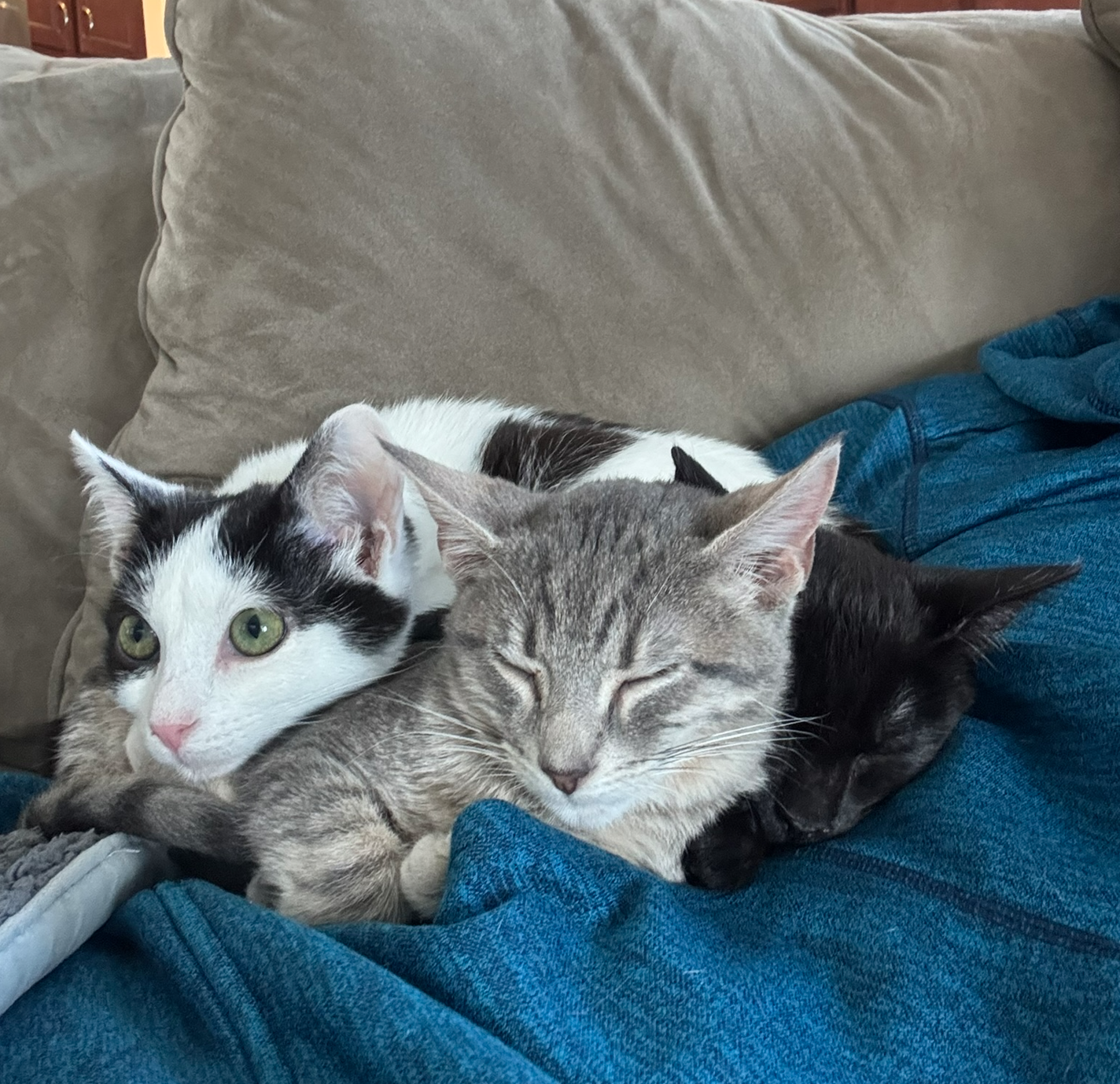
Fiona, with her beautiful white coat and black spots, was sitting among a litter of all-black cats. It was impossible not to notice her. What stood out even more was her affection for Ramona. The two of them curled up together looked completely inseparable. After spending time with them during our first visit, I knew the rest of the family would fall in love.
After several trips to introduce everyone, we decided to adopt them both. During one of our final visits, my wife met a little boy cat named Johnny who had recently arrived. We thought adding a loving male cat to the family would be wonderful, and with her blessing, we brought him home as well.
When they first arrived, we kept them separated. The girls stayed in the laundry room, and Johnny stayed in the bathroom. From the very beginning, the kids were completely invested. Every morning before school and every afternoon after getting off the bus, the questions were always the same:
“How are the cats doing?”
“Where are the cats?”
Watching my youngest carry little Johnny around, it was obvious he had found his favorite. My wife adored him too. My oldest daughter quickly bonded with Ramona and her striking black coat. As for me and my youngest daughter, we completely fell for Fiona.
Once all three cats were introduced, they became inseparable.
They soon became known as the Three Amigos: Johnny, or “John John”; Ramona, or “Mo Mo”; and Fiona, our “Fi Fi.”
Not only did they bring endless joy to our children, but they did everything together. Three cats in the window. Three cats sharing the same bed. If one settled down for a nap, the others would soon curl up beside them. More often than not, all three would end up asleep on my lap.
Every night around ten o’clock came their version of the witching hour, filled with chaos and energy. It was never just one or two of them. Wherever one went, the others followed.
Of the three, there was one cat who completely stole my heart.
Over the years, most of the cats we’d loved and cared for had been fairly independent. None really enjoyed being held. Snuggles were brief, and visits to your lap were usually short-lived. After twenty years of caring for cats, I had never really had a true lap cat.
That changed with Fiona.
As I worked in my office, she was always the first one downstairs. I’d hear her distinctive meow before she appeared, and inevitably the other two would follow soon after.
At night, once the kids were asleep and I settled onto the couch, Fiona would be the first to greet me. She had this special way of walking into my arms, rolling onto her side, and burying herself into a deep cuddle. In the kitchen, while Johnny and Ramona claimed spots on the counters, Fiona preferred stretching out on the rug below, demanding belly rubs.
For the first time, I had a companion who genuinely wanted to be by my side.
The beginning wasn’t easy, though.
One of the cats came home carrying a parasite that we believed had been treated before we introduced them. Unfortunately, it wasn’t. The next several months were spent giving all three cats medication, something they absolutely hated. It was hard on them, and honestly, it was hard on me too.
But we persevered, and after a second round of treatment, they all appeared healthy and happy.
Then, in June, things changed.
One evening, I noticed Fiona struggling to jump onto the couch beside me. I assumed she was tired and lifted her up. She happily settled next to me, and when I went to bed, I left her sleeping comfortably on the couch.
The next morning, when I went to feed the cats, I noticed she was struggling to walk.
I spent Father’s Day sitting in an emergency veterinary hospital for eight hours waiting for her to be seen while my family waited anxiously at home.
That was the beginning of a months-long battle to save her life.
She was diagnosed with FIP.
Until recently, FIP was considered a devastating disease with a very low survival rate. Advances in modern medicine have changed that dramatically, with success rates now around 90 percent. I was willing to fight for her. For my family. For her siblings. And for the cat who had shown me just how extraordinary she was.
I genuinely believed she would become a success story.
I believed that if I followed every instruction, kept every appointment, administered every medication, and did everything possible, she would recover.
Despite the setbacks, despite the moments when it felt like the disease was gaining ground, we always had another option to try. Another treatment. Another plan.
I never truly believed she wouldn’t make it.
But things happened quickly.
Her body simply couldn’t keep fighting.
Today, Johnny and Ramona are doing well, though they clearly miss her. The dynamic in our home is different now. What we hoped would be many years of love, laughter, and chaos has instead become a period of healing and finding a way forward.
Shortly after Fiona passed away, I spent a lot of time thinking about how to honor her.
Eventually, I reached out to Viagen.
I had never seriously considered cloning a cat before, but I knew I wanted to do something special for Fiona. Their staff walked me through the process, answered every question, and treated me with incredible compassion. The first step would be determining whether her cells could be successfully cultured, a process that would take several weeks.
The past few weeks have been an emotional roller coaster for my family and me.
I didn’t know whether the process would work, and I didn’t want to get my hopes up. We are still healing, and in their own way, so are Johnny and Ramona.
I wasn’t sure what I would feel when the answer finally came.
Then one afternoon, while sitting in a parking lot waiting to pick up my child from practice, the email arrived.
It was a success.
I felt an overwhelming sense of relief.
A part of the cat I had fought so hard for and grown to love so deeply had, in a way, been given another chance.
A cloned cat is not the same cat returning to life.
Rather, it is a continuation of everything that made them special. It is an opportunity to carry forward a small part of what made them extraordinary. For me, it represents hope. A chance to heal something that could not be fixed. A way of honoring a promise that I would do everything I could for someone I loved.
We miss having the Three Amigos.
We miss Fiona every single day.
But for the first time in a while, the future feels like it holds a little more possibility.
