

Key Takeaways:
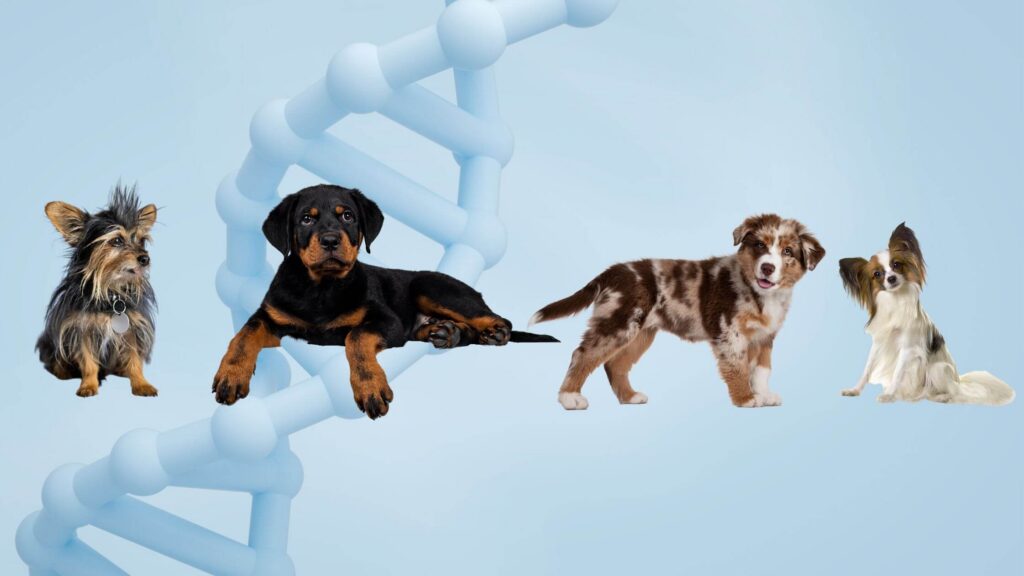
- A cloned dog is a genetic twin, not a replacement. A clone shares the same DNA as your original dog, but it will develop its own personality, memories and relationship with you.
- Dog cloning is a scientifically established process called somatic cell nuclear transfer (SCNT). The technology uses your dog’s DNA to create an embryo that is carried by a surrogate mother and developed into a healthy puppy.
- A cloned dog can look and behave remarkably similar to your original pet. However, small differences in appearance, temperament and personality are natural because every dog is shaped by both genetics and life experiences.
- Your cloned dog will be expected to live a normal, healthy life. ViaGen provides veterinary monitoring throughout development, genetic verification after birth and ongoing care to support the health and wellbeing of cloned puppies.
- Safety and animal welfare are central to responsible cloning. The process involves veterinary-led tissue collection, surrogate care, controlled laboratory conditions and continuous monitoring of every animal involved.
Table of Contents:
- How dog cloning works
- Our 6-step dog cloning process
- Health, safety & guarantees
- Real-life examples
- Expectations
- Ethical considerations
- Conclusion: Should you clone your dog?
“Can you clone a dog and have it be the same as the one you love?”
It’s a question many dog owners are asking, and one we hear daily here at ViaGen Pets—and the answer may surprise you.
In this article, I’ll walk you through the science and the stories of people who have cloned their dogs in real life, including what it feels like to meet a cloned pet for the first time. By the end, you’ll know whether dog cloning could be right for your pet.
So let’s get started.
How do you clone a dog? Here’s a 2-minute look at the science:
The science behind dog cloning is called somatic cell nuclear transfer (SCNT). This is a jargon term for the technique used by scientists to create new organisms using the DNA of existing ones.
The technology has been around for a while. SCNT was made famous in 1996 when the first cloned mammal from an adult cell was born. You may remember her: Dolly the sheep. This made international headlines precisely because Dolly was a mammal. Before then, most SCNT was on lesser newsworthy animals, such as frogs.
The science of cloning dogs came later, because of their more complex reproductive biology. It wasn’t until the mid-2000s that dog cloning became a safe, refined and commercially available process.
In simple terms, the nucleus (which contains DNA) from a body cell of the animal you want to clone is put into an egg cell that has had its own nucleus removed. This egg is then stimulated to develop into an embryo and implanted in a surrogate mother.
It might sound like the stuff of science fiction, but you can clone a dog and the process is straightforward.
Our Straightforward 6-Step Dog Cloning Process
With the above science in mind, here’s broadly what you can expect if you choose to clone a dog at ViaGen Pets, which is in line with the industry standard:
- Enquire with us, and we’ll take steps to start preserving your dog’s DNA. If your dog is unwell or has died, then we will provide emergency instructions and guide you through the process.
- A veterinarian will collect a small tissue sample, which will then be refrigerated and sent to our lab.
- Once we receive the sample, we will culture new cells from the tissue. This usually takes about four weeks.
- Once you are ready to begin cloning, we will initiate the SCNT process into a healthy surrogate mother.
- The surrogate will carry the pregnancy for a normal 60-65-day gestation and will nurse the puppy for about 56 days. You’ll be kept informed throughout this entire period with regular updates and weekly photos of the developing puppy.
- Once your cloned puppy is weaned and the veterinary checks are complete, you will receive your cloned dog, and we will provide an independent genetic report proving that the clone and the dog share identical DNA to the tissue sample.
|
💡 |
Good to know: The cost to clone a dog is $50,000 and you only need to pay half of the cost upfront, and the remainder when the clone is delivered to you. If for whatever reason, we cannot clone your dog, then you will receive a 100% refund. Read more here: How much does it cost to clone a dog? |
Common questions we receive on the health & safety of dog cloning
It’s natural to have some health anxieties when it comes to dog cloning, just like it’s natural to worry before undertaking any big procedure. We generally hear the same three types of concerns, and there’s a good chance you’ve already encountered some of them during your research.
Allow us to address all of these anxieties head-on, based on our experience, honestly and transparently.
Concerns about your dog clone’s health
| Concern: | Our response: |
|---|---|
|
“I’m worried my dog’s clone might have genetic defects or abnormalities.” |
When you receive your clone, you will get an independent third-party report that proves your clone is in good health and is, in fact, an identical genetic twin to your original dog. |
|
“I’m worried that my clone won’t age normally and may live a shorter life.” |
We have seen no evidence that clones live shorter lives. We attribute this to a myth around Dolly the sheep. Dolly is said to have died from a cloning-related illness, and the myth goes that this was because she was cloned from an older animal with older, shorter telomeres. But the reality is that cloning has been shown to reset telomeres during the embryo creation process, so your clone will have telomeres that look and act normally for a newborn animal. We’ve written extensively on this topic here: Are cloned pets as healthy as other pets? |
|
“I’m worried my clone will be more susceptible to disease.” |
Your clone’s DNA is identical to your dog’s, so it will have the same genetic predispositions. Throughout the entire cloning process, the health of your clone is closely monitored. And our lab follows strict, world-leading scientific and veterinary protocols to encourage natural, normal development. |
|
“I’m worried my clone won’t have the same personality as my dog.” |
Many behavioral traits come from genetics, while others are influenced by environment and upbringing. So it is entirely possible that your clone will behave similarly. But it’s also likely that it will develop individual quirks and a temperament that will naturally develop over time. This is all normal and part of the uniqueness of every dog. |
Concerns about safety in the cloning process
| Concern: | Our response: |
|---|---|
|
“I’m worried there is pain involved for my dog and/or the surrogate mother.” |
In order to collect tissue from your dog to cultivate cells, a biopsy is needed. The risks involved are extremely low, and the whole process is performed under local anaesthesia. As for surrogate mothers, they receive world-class veterinary care, nutrition and monitoring throughout the entire pregnancy and nursing period. We follow strict ethical standards and only use healthy surrogates to ensure their safety and well-being. |
|
“I’m worried the cloning process might fail multiple times, requiring several surrogates to undergo distress.” |
As mentioned above, all surrogate mothers receive world-class veterinary care, nutrition and monitoring throughout the entire pregnancy and nursing period. |
Concerns about the overall outcome of your dog’s clone
| Concern: | Our response: |
|---|---|
|
“I’m worried my clone won’t be exactly like my beloved dog.” |
Your clone will be a genetic twin—an identical twin— of your dog. There may be slight differences in appearance. A cloned Dalmatian might have some variance in its spots, for example. But this is actually normal and expected, and part of the rich tapestry of life. Think of your clone as the same ‘recipe’ as your original dog, rather than a photocopy. The DNA is a 100% match. But clones may show very slight differences in markings or size due to epigenetic factors. Epigenetics are influenced by many complex factors. Even the position in which the puppy sits in the womb can influence the expression of certain genes. |
|
“I’m worried that my expectations won’t be met and that my clone will be too different and therefore disappointing.” |
If you are looking for a “copy-paste” of a personality, then cloning might lead to disappointment. If you are looking to preserve a special genetic line and want a puppy with the raw materials of your soulmate dog, as many of our clients do, then it is hard not to see cloning as anything other than a miracle of technology. We find it helps not to think of replacing a lost friend, but starting a new chapter with a version of your dog who will get the chance to learn to love you all over again. |
|
“I’m worried that cloning isn’t ethically safe.” |
At ViaGen, we adhere to strict ethical and animal welfare standards. All of our procedures prioritise the health and safety of surrogates and cloned puppies. |
Can you clone a dog? Here are some real-life examples:
We have successfully cloned more than 1,000 dogs and cats, making ViaGen Pets one of the world’s leading commercial pet cloning companies. And in that time we have worked with many celebrities.
Perhaps our most well-known celebrity partner is Barbara Streisand, who cloned her Coton de Tulear, Samantha, after Samantha died in 2017. The process produced two cloned dogs: Miss Violet and Miss Scarlett.
Paris Hilton and Tom Brady are other high-profile celebrities who have partnered with ViaGen for successful dog cloning.
|
📌 |
You can read more about these real-life examples here: |
Expectations: What should you expect from a cloned dog’s appearance, personality and health?
Here are some common FAQs we hear about on the Internet and via our customers. We’ve touched on these in our ‘concerns’ section above, but these are so important for you to understand that they’re worth repeating:
- Will my cloned dog actually be my dog again?
No. Your cloned dog will have the same DNA as your original dog, but it won’t be the same dog.
Instead, it’s best to think of your cloned dog as a genetic twin born at a later date, as the clone has the same genetic identity as the original dog, similar to naturally occurring identical twins. It shares the same genetic blueprint, but it is a new individual.
Anyone who knows (human) identical twins in real life will know that although they share many of the same traits in both appearance and personality, they are still distinct people with their own personalities.
- Will my cloned dog look like my old dog?
Yes, for the most part. Your cloned dog may look remarkably similar, but it may not be an exact visual copy.
Cloned dogs often share the same intelligence, temperament, and appearance as the original. But small differences can happen naturally. The cloned pet may have slight phenotypic differences, such as different markings due to natural epigenetic factors.
Even identical human twins have the same DNA but can have subtle differences in appearance.
For example, a black-and-white spotted dog clone will still be black-and-white spotted, but the exact spot pattern may vary.
- Will my cloned dog have the same personality?
Yes and no. Your clone may share familiar traits, habits and temperament, but it will build its own relationship with you.
Many owners of cloned animals tell us that they exhibit many of the mannerisms of the original animal. But personality traits are a combination of genetics, environment, and experiences.
We can provide you with a genetic match, but the environment the original animal was raised in simply cannot be copied. The environment that the cloned puppy is nurtured in will play a large role in the development of its personality.
We cover this in more detail here: Do cloned animals act the same as the original?
- Will my cloned dog ‘remember’ my original dog’s life?
No. A clone will not remember your previous dog’s favourite walks, routines, training or relationship with you. You are continuing a genetic legacy, not bringing back the exact same dog.
Ethical considerations: Is cloning a dog the right choice for you?
Welfare ethical considerations
Choosing whether to clone your dog is a deeply personal decision. For many owners, the idea comes from a simple place: wanting to preserve the bond they share with a beloved companion.
Responsible cloning depends on prioritizing the health and wellbeing of every animal involved, from the original pet providing the DNA sample to the surrogate mother and cloned puppy.
At ViaGen, we assume full responsibility for the long-term care and well-being of all egg donors and surrogates, and their wellbeing remains a central responsibility throughout the process.
The cloning process itself takes place in US-based, high-health and bio-secure facilities, and each animal involved in the cloning process is continually cared for by an expert veterinarian and trained ViaGen team, and are watched and monitored continually to ensure the animal’s comfort, health, and well-being.
For owners considering cloning, understanding these safeguards is an important part of deciding whether this option aligns with their values.
Philosophical ethical considerations
While it’s not our place to persuade anyone on their own philosophical considerations, at ViaGen, we believe that love doesn’t end with goodbye and neither should the bond you share with your companion.
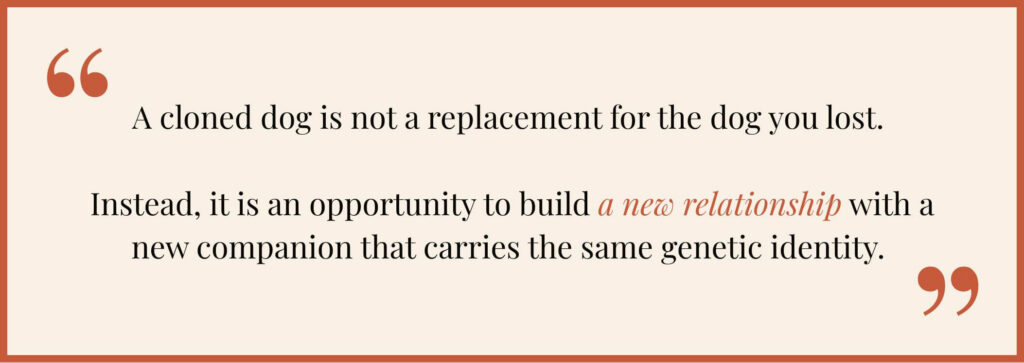
The purpose of cloning is not to erase loss. It is to create the opportunity for a new relationship with an animal that shares the same genetic identity.
Humans already use science to improve animal health, extend lifespans and support reproduction. Cloning is another example of biotechnology being applied to the human-animal bond.
And while modern science cannot bring back the exact same dog, it can preserve the genetic identity of a companion and give owners the choice to continue that connection in a new way.
Conclusion: Can you clone your dog and continue the bond you share?
Dog cloning cannot bring back the exact same dog, but it can preserve the genetic identity of a beloved companion and create the opportunity for a new relationship with a genetic twin.
By understanding how the science works, what to expect and how ViaGen prioritises animal welfare, you can make a confident decision about whether cloning is the right choice for you and your pet.
Your dog’s life may be finite, but the bond you share does not have to disappear. Learn how ViaGen Pets can help you preserve your companion’s genetic legacy and explore whether dog cloning is right for you.
Click here to visit our service page on dog cloning to get started.
Read more: How to clone a dog? & How much does it cost to clone a dog?
